Norman Hyde (Triumph Motor Cycles)
Starting in 1969, a few of my mates and I used to go over to Santa Pod which had not that many years earlier had opened for Drag Racing. Drove over in my Ford Anglia, with five of us in the car and then when we got to the Pod, one jumped in the boot, so he could get in for free.
I can still remember some of the bikes, Slippery Sam, a Triumph Trident engine bike, Pegasus a supercharged Vincent, some other mad bikes ridden by Elmer Trett from the USA and Henk Vink from Holland, who had at one time a Rocket powered Bike.
We got to know many of the motorbike racers and my mate John eventually went on to work for Norman at his shop on Montague Road in Warwick somewhere around 1978.
Norman Hyde moved to new premises on the Heathcote Estate in Warwick and he also manages to acquire the main gates from the Meriden Factory and installed them at the new workshop’s entrance at Rigby Close.
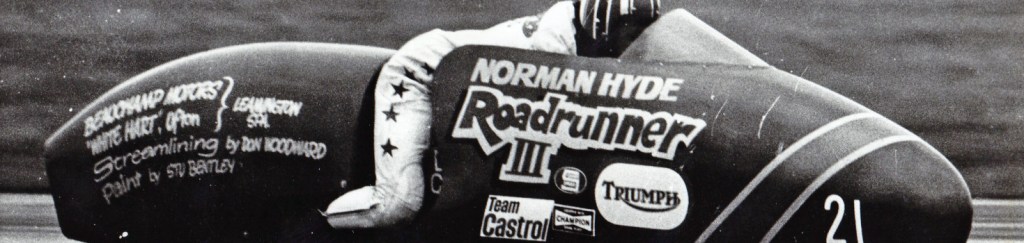
In 1972, Norman held the World Sidecar Land Speed Record at an average speed of 161.8mph, a record that remained unbeaten for over 35 years.
Even his van had the need for speed and I fitted a ZF gearbox into it one year, helped by my mate John and in the depths of winter with a couple of inches of snow on the ground.
Not sure if or when Norman Hyde retired, but the old website stopped in 2015.
I see the name still exists though, so not sure if it is still him or if he sold it to another concern.
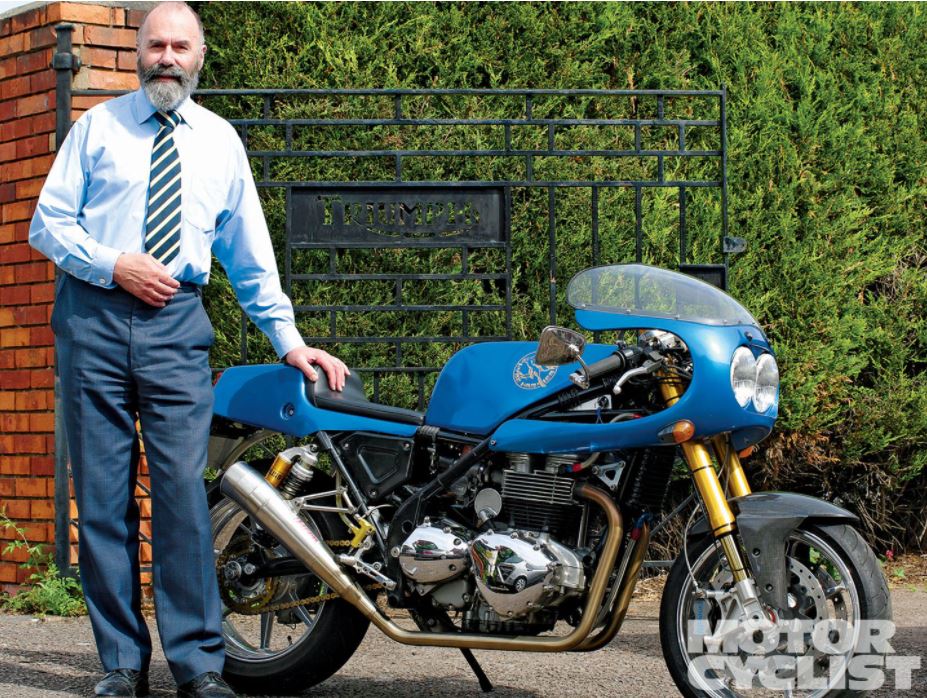
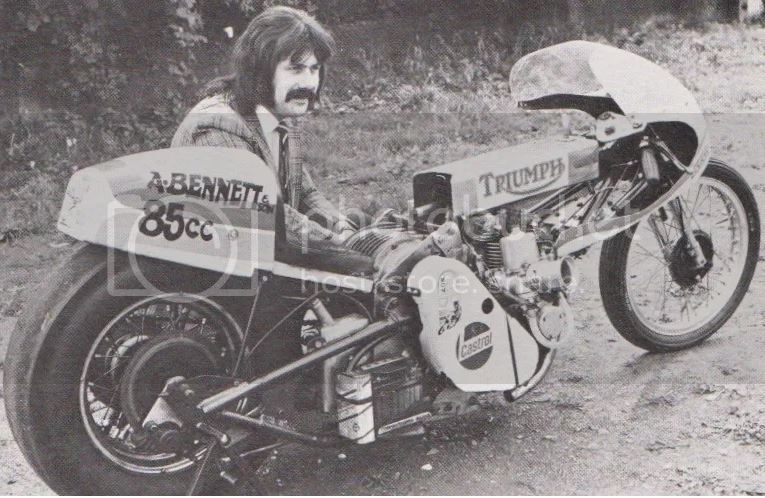
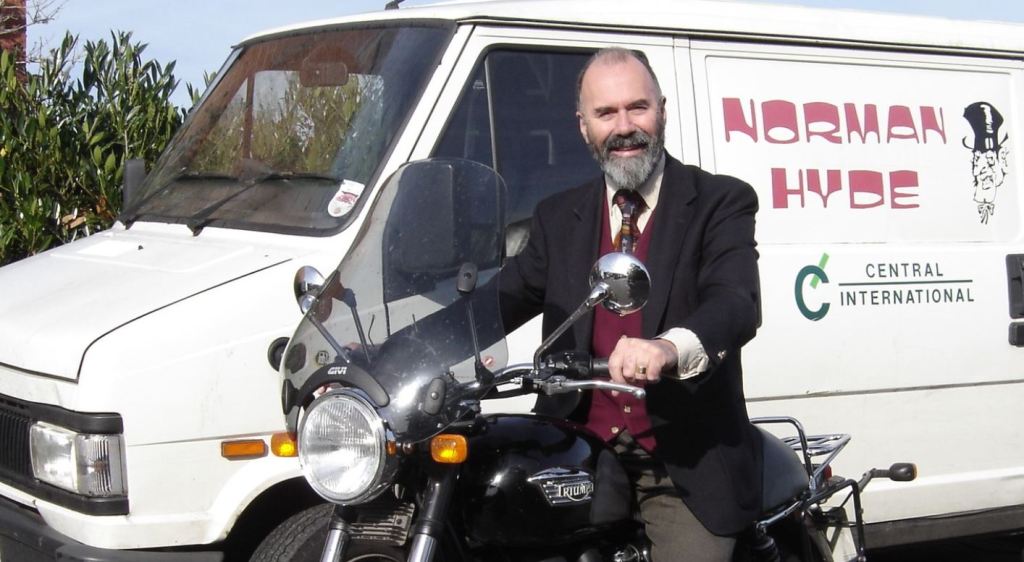
Norman still doing his bit….
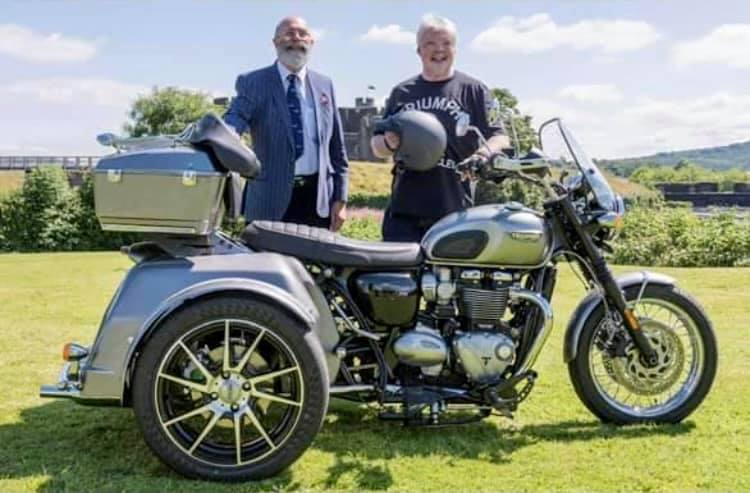
Bespoke Triumph Trike For War Hero Simon Weston.
Disabled Falklands veteran Simon Weston, CBE has taken to the road on a bespoke built Triumph trike partially financed by crowdfunding. Simon was presented with the gleaming machine just days before his 60th birthday by former Triumph engineer and world speed record holder Norman Hyde, who initiated the £25K project two years ago.
Triumph Motorcycles donated a new 2020 T120 Bonneville to act as the base of the design and Hyde selected Trike Design of Caerphilly, South Wales (coincidentally Simon’s hometown) to build and create the trike conversion, with adaptive controls.
In addition to the motorcycle donation from Triumph Motorcycles, crowdfunding brought in the remainder of the build cost with generous single donations from five pounds up to four-figure sums.
Simon said: “I’m living my dream. When I was young, my late mother made me promise never to have a motorbike, but I had wanted a trike for years. I cannot thank Norman and the many people who donated for their kindness and generosity and turn my dream into reality.”
Serving with the Welsh Guards during the 1982 conflict in the South Atlantic, Simon suffered 46 per cent burns at the age of 20 when the ship he was on was bombed from the air. As a result, he lost fingers from both hands.
Norman Hyde said: “When I met Simon two years ago, he told me of his passion to ride a trike. Knowing the sacrifices and bravery Simon had shown to our country combined with the good and willing people in the British biking community, I immediately thought about trying to help make Simons dream happen.”
Along with Triumph, many other trade names backed the project including the MCIA, LS2 Helmets, Held clothing brand – who made bespoke gloves for Simon – and finally the various suppliers of parts and services to Trike Design. The Triumph Owners MCC donated a substantial sum towards the build.
Hank Hancock of Trike Design, specialists in building three-wheelers and adapting machines for disabled riders, paid tribute to his long-standing associate Robin Davies for developing the adaptions to suit Simon, who took readily to the trike after a couple of lessons.
Simon said: “I soon worked out how to ride it I didn’t want to stop! I have never ridden a two-wheeler, so I didn’t have any preconceptions.” Once fully confident, Simon hopes to entice his wife Lucy onto the pillion seat.
About the trike build
The rear end conversion is Trike Design’s latest Brooklands Sport design. With the rear wheel and other components removed, the swingarm was cut back and adapter pieces welded on to ensure a subframe could be attached safely at several points. The subframe supports the independent suspension and an anti-roll bar for the 17in alloy rear wheels.
The chain drives twin shafts via a central differential, vital for smooth cornering. Disc brakes assembled from car components retain the relocated original ABS and a handbrake complies with regulations. The neat GRP enclosure has a boot taking two helmets and there is more carrying space in the top box. Stainless exhaust pipe extenders place the outlets behind the bodywork, with the system mapped to suit. At the front, custom-made fork yokes reduce trail by a few degrees to make the steering lighter.
Ingenious work by Trike Design’s Robin Davies adapted the controls for Simon. A right-side pedal applies the brakes via two master cylinders, with automatic front-and-rear compensation. Outboard of it, another pedal provides fly-by-wire throttle control. On the left, a pedal and linkage operate the clutch.
Kliktronic electric gear-shifting is by buttons on the handlebars, for downward changes on the left and upward on the right. A hand lever on the right of the machine used with another button activates a winch motor to provide reverse drive for parking and manoeuvring. The pulled-back bars have hand guards donated by Triumph to prevent Simon’s hands, which have poor circulation, from getting too cold.
About Simon
Simon Weston had been in the Army’s Welsh Guards regiment for five years when he sustained life-changing injuries. He was aboard the Royal Fleet Auxiliary ship Sir Galahad, carrying fuel, ammunition, and incendiaries, when it was attacked by the Argentine Air Force. Forty-nine of Simon’s fellow Welsh Guards were killed in the inferno.
Undergoing 97 operations over many years, Simon has lived through some dark times, and he credits his mother Pauline with helping him become more positive and face the reality of his experience.
Simon became nationally known through TV interviews and programmes such as This is Your Life and devoted his energies to several charities. Decorated with military medals, he was awarded an OBE in 1992 and made a CBE in 2016 for charitable services. Granted the Freedom of Liverpool, he has an honorary doctorate from Heriot-Watt University and is an honorary fellow of Cardiff University. Simon continues to be a strong advocate for troops’ and veterans’ rights and is an inspirational speaker on mental wellness.
A DAY AT THE NMM WITH NORMAN HYDE & THE TRIUMPH OWNERS MOTORCYCLE CLUB
The National Motorcycle Museum ·
Celebrating 50 years of record-breaking!
On 24th September this year and with Roadrunner III on display at the National Motorcycle Museum, Norman will be reunited with his outfit for a day to celebrate his world record-breaking ride.
Come and join us at the museum between 10.00am and 3.00pm on 24th September, where all TOMCC members will get half-price admission on the day into the museum.
Fifty years ago on 24th September 1972, our T.O.M.C.C. Patron Norman Hyde, wheeled his nitro-methanol burning 830cc Trident-powered outfit ‘Roadrunner III’ onto the runway at the RAF base of Fairford in Gloucestershire. The home of Concorde. He was going to attempt to break the flying kilometre world speed record held by George Brown at 158.23 mph.
To be officially recognised by the F.I.M., Norman had to beat Brown’s existing record by at least one percent (more than 1.58 mph). No stranger to breaking speed records, he already held numerous British and World records, all set on a number of different capacity Triumph-engined machines. But this was going to be the big one. He wanted to become the fastest sidecar rider in the world.
Preparing Roadrunner III for the record attempt had only been completed just three days before the event was to take place. Over 250 hours of planning had gone into it including Norman slimming down to the lightest weight he had been for more than five years.
Being a Triumph factory development engineer at Meriden, the company had given him their backing and Don Woodward, who made fuel tanks for the works road race bikes, fashioned the alloy streamlining for the machine.
On the start line at RAF Fairford, the first challenge was to be the standing quarter mile record and Norman launched Roadrunner III off the line with the front wheel pawing the air a foot off the ground. Records had to be set over two runs held within one hour, one each way, and after averaging 11.51 seconds (78.19 mph) over the two, he had set new World and British records. Things were looking good and next in line was the standing kilometre record.
On standing starts and due the sheer power of the three-cylinder Trident engine, Norman was leaving the line on full right-hand lock for the first 80 yards. Undeterred, after two runs the old record was gone and with an average of 21.285 seconds and 105.09 mph, he now held a new world standing kilometre record to go with the standing quarter mile one he had just taken. Two down now, just the big one to go. The flying Kilometre.
With a fairly strong wind blowing up and down the runway, Norman set the fuel at 25 percent nitro and with the wind at his back the first run was completed at 158.8 mph, meaning he had to pick up more than 5 mph into the wind on the return. Accordingly, the nitro content was upped to 37.5 percent.
Despite the wind giving him problems in keeping the outfit in a straight line and the front wheel lifting on reaching top speed, Norman kept the Trident engine screaming flat out as Roadrunner III shot through the timing lights. A check of the timing sheet showed he had missed out on the record by just 0.2 mph!
With records being calculated on the two last runs, Norman decided to try for a third one. The three-cylinder engine was hot and the team removed the spark plugs before pushing the machine around in gear to let cool air enter directly into the cylinders. At the start of the run the engine spluttered onto two cylinders, but luckily Norman managed to pull up before going through the marker boards. A change of spark plug made no difference and just as he was about to call it a day, the engine began to fire on all three. This really was the last chance.
With a red hot motor that may be on the point of seizing, Norman had to decide whether to ride with two fingers on the clutch lever or hang on tightly to the left handlebar in an attempt to control the outfit at speed.
There was around a kilometre of run up before entering the timed section and in Norman’s own words, “I never looked at the road. My eyes were firmly glued to the revcounter. 8,100, 8,2, 8,3, 8,4, 8,5. I thought for Christ’s sake keep going.”
Thankfully it did and he had taken the record with a run of 13.93 seconds one way and 13.72 the other, giving an average of 13.825 for both runs and a new world record speed of 161.80 mph.
All he had to do then was pay £5 to the F.I.M. for the parchment certificate in both French and English to prove it!
If you would like more information on this event, please contact: events@tomcc.org
 Motoring History of Leamington Spa & Warwick